FHA Minimum Property Standards Checklist



FHA minimum property standards ensure that homes financed with an FHA loan are safe, secure, and sound.
FHA-approved appraisers confirm that a property meets these requirements during the appraisal, allowing buyers to spot red flags early in the home search.
FHA appraisals can make or break a deal, but knowing what to look for ahead of time can help you avoid costly surprises.
The FHA appraisal protects buyers, but it can feel like a roadblock to your dream home if you’re unfamiliar with the process. Wouldn’t it be great if you knew what to avoid during the house-hunting process to help predict whether a home would pass the FHA appraisal?
You should know that you’re not entirely powerless. As it turns out, you can look up the FHA minimum property standards.
Minimum property standards (MPS) are standards set by the Federal Housing Administration (FHA) that require all properties financed through the FHA loan program to be safe, secure, and sound. But what specifically falls under each of those categories?
Safe: The property should be structurally sound and free from hazards that could pose a risk to the occupants. This includes ensuring that the roof, walls, and foundation are in good condition and that there are no major safety concerns, such as exposed wiring or unstable flooring.
Secure: The property should provide a secure living environment. This includes functioning locks on all exterior doors, windows that open and close properly, and adequate lighting in common areas/entrances.
Sound: The property should be free from significant defects affecting its value or habitability. This includes checking for issues such as water damage and plumbing, electrical, or HVAC system problems.
Minimum property standards give families confidence and security about their investments. Safety, security, and soundness are just the core tenets of the MPS; the FHA has an entire handbook dedicated to what is and isn’t acceptable for a property. The handbook provides guidance for everything from site design to construction, which is why FHA appraisers exist, to make the process easy.
FHA-approved appraisers enforce minimum property standards. Not only do they ensure that the property meets FHA standards, but they also determine the home's market value. The FHA trains and authorizes appraisers to evaluate properties and ensure they meet the required standards.
Every FHA loan requires an FHA appraisal to confirm the home meets FHA minimum property standards and to determine the home’s fair market value. However, an FHA appraisal is not a complete home inspection.
While the appraiser checks for obvious safety and structural concerns, they do not inspect the home as thoroughly as a licensed home inspector. An inspection examines the property’s internal systems, structural components, and potential hidden issues that an appraisal might miss.
Remember, an appraisal is required for the FHA loan, and an inspection is optional but highly recommended to get a more complete picture of the home’s condition.
If the property fails to meet minimum property standards, the appraiser will note the deficiencies in their appraisal report. For the loan to proceed, the lender will require the defects to be addressed so that the home meets a passing standard.
At this point, the buyer must reach an agreement with the seller over who will finance the repairs to bring the property up to standard. If an agreement cannot be reached or the appraisal price is low, you'll likely have to resume the house hunt. Borrowers are protected in this instance by the FHA amendatory clause, which allows the buyer to either walk away or renegotiate without financial penalty if an agreement on the purchase price of the home cannot be reached after the appraisal price is low
This can be disheartening, and it isn't easy to let go of a home once you've envisioned it as yours.
However, the situation is not as powerless as it seems. While buyers cannot replicate the appraisal process, there are several key items to look for. Identifying potential red flags during the home search can bring peace of mind that you are doing everything in your (limited) power to avoid a home appraisal failure.
Whether you’re interested in a listing or touring an open house, here’s a list of things buyers can look for that may be considered red flags to an FHA appraiser:
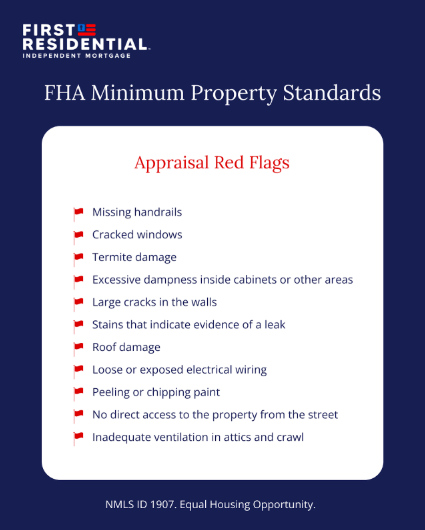
Buyers cannot replicate the appraiser's job. The FHA requires approved appraisers for a reason. Thankfully, the items above are all pretty easy to check for, and if you highlight one or more potential red flags in a home, it gives you a chance to see whether the seller would be willing to address them, or it might be a great sign to keep looking.
Buyers should also be aware of specific FHA minimum property standards. Below, we’ll discuss some rules and include questions you can pose to yourself or the seller to help determine whether a home is up to FHA standards. You could also find answers in the listing.
The FHA has specific requirements regarding peeling paint for properties built before 1978. This requirement is related to the potential presence of lead-based paint, which can be hazardous, especially for young children.
For properties built before 1978, the FHA requires that any peeling, chipping, or deteriorated paint be addressed if the appraiser determines it poses a risk of lead-based paint hazards.
The appraiser will identify such areas during the appraisal process.
It should also be noted that the HUD-EPA Lead Disclosure Rule states, “If the property was built before 1978, the seller must disclose any information known about lead-based paint and lead-based paint hazards before selling the house.”
Does the home have water stains on the walls or ceilings? Do shingles look missing or warped?
These are strong indicators that a home’s roof may not meet FHA standards. The FHA requires that the roof be fully functional, meaning no leaks or severe damage.
The FHA also states that the roof should have at least two years of remaining life.
Generally, the FHA requires that crawl spaces be free of debris, moisture, signs of pest infestation, and signs of structural issues. Crawl spaces must also have proper access and ventilation.
FHA requires functioning windows for safety and security. Broken latches, stuck windows, or those painted shut typically require repair. Damaged panes are also considered safety hazards and must be replaced before the loan can be approved.
Additionally, windows must be free of rot and severe deterioration, properly weatherproofed, and free of condensation between double-pane windows.
FHA follows the standard building code, which requires each bedroom to have at least one window large enough for escape or rescue in case of an emergency.
FHA loans require a minimum square footage for manufactured homes: 400 square feet or more to comply with FHA standards.
The FHA does not have a minimum square footage requirement for properties other than those listed.
Have more questions about what to expect in the FHA minimum property standards process? Contact a First Residential loan expert for more information.
FHA property standards are stricter than conventional loan requirements, but they are focused mainly on health, safety, and structural integrity. The goal isn’t perfection, it’s ensuring the home is safe to live in and a sound investment.
Yes. In most cases, the seller can complete required repairs to bring the property up to FHA standards so the loan can proceed. Buyers and sellers can also renegotiate the purchase agreement, such as adjusting the price or requesting credits, depending on the situation.
Yes, but the home must still meet FHA minimum property standards, or be brought up to standard before closing. If significant repairs are needed, buyers may consider an FHA 203(k) renovation loan, which allows you to finance both the purchase and repairs.
Tyler Oswald is a Production Training Team Lead at First Residential, where she’s revamped training to make it more effective and engaging. With a strong background in FHA, Conventional, and USDA home loans, she’s all about equipping loan teams with the tools they need to succeed while keeping things collaborative and aligned with First Residential's values.
More articles by Tyler Oswald